

The purchase process in Spain
Buying property in Spain? Start with a clear legal overview
Understand the key legal steps before making any decision
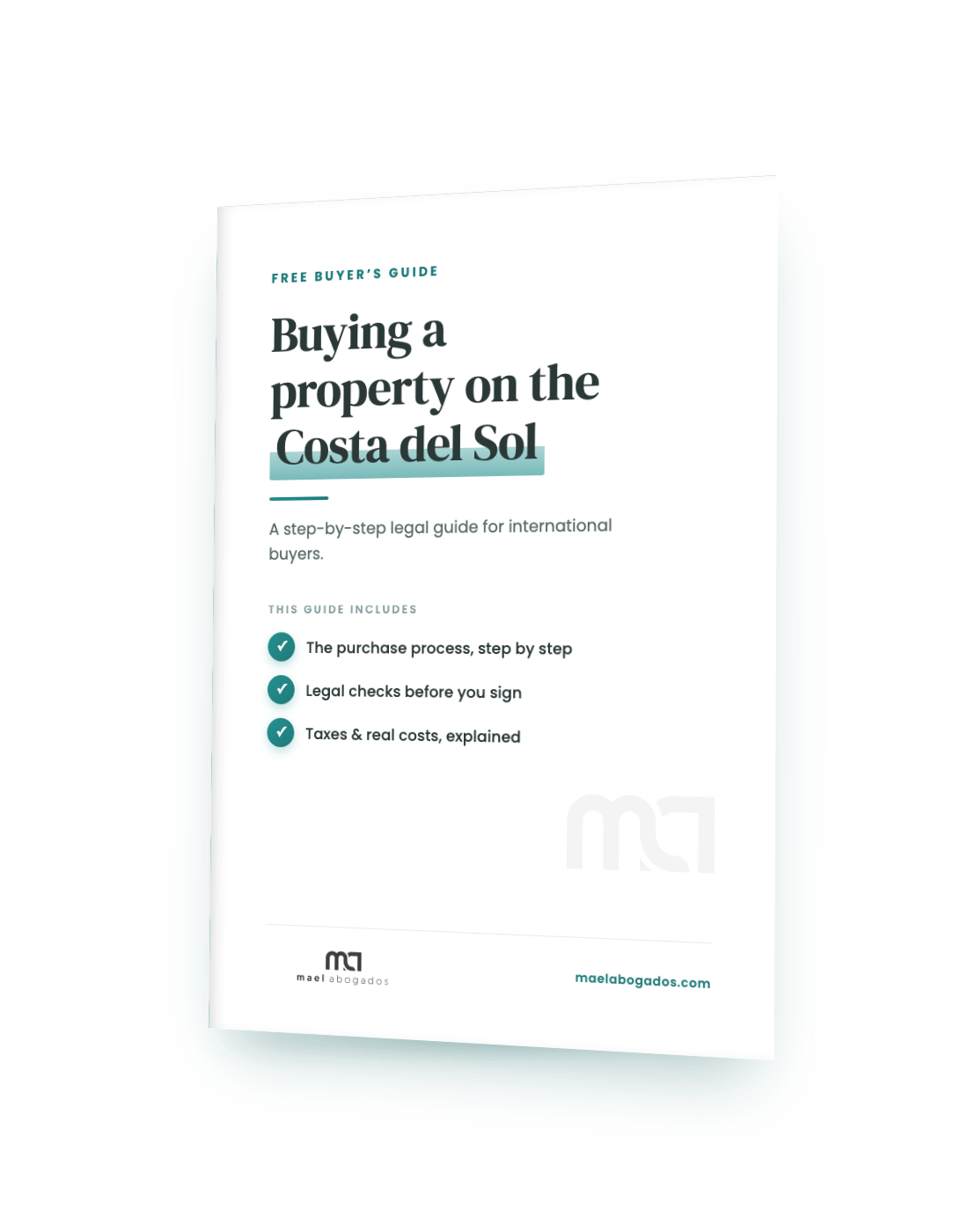
Access the guide
Spain, with its lifestyle, climate, and people, has been a popular destination for foreign buyers looking to establish residency or enjoy a holiday home.
This can make the process of buying a property in Spain seem daunting, especially for expats navigating the bureaucracy of a new and unfamiliar country. However, rest assured that any foreigner can buy a property in Spain and that the process is secure and simpler than you might think if you have the right professionals by your side.
If you are considering buying a property in Spain, we recommend reaching out to a local real estate agency that can assist you in finding a property that suits your needs. They can save you time and help you identify market prices and negotiate a good deal with the seller. Once you’ve reached an agreement with the seller, the purchase process will begin, as outlined below:
Before you commit to a property, it helps to see the numbers: you can calculate your purchase costs for Andalusia in ten seconds with our free tool.
The reservation document
The reservation document outlines the terms of the agreement between buyer and seller. It includes the purchase price, property details, information about the parties involved, and an estimate of the timeline for the transaction and property handover. It typically involves a deposit payment to secure the property and demonstrate the buyer’s commitment. This deposit is usually held by the buyer’s lawyer or, in some cases, by the real estate agency.
The private purchase contract
After verifying the property documentation and confirming that there are no legal barriers to the purchase, the next step is signing the private purchase contract.
In Spain, the most common legal form is the “arras penitenciales” contract, although other types of contracts are also used, all of which bind the parties to fulfill their obligations.
This contract includes the identification of the parties, a detailed description of the property, information about existing charges, reasons for breach of contract, and the deadline for the public deed of sale. It is usually accompanied by a payment of 10% of the purchase price, which can be adjusted by mutual agreement.
The public deed
The public deed is a document signed before a notary public, in which the seller transfers ownership of the property to the buyer in exchange for payment. This is a significant moment in the process as it signifies the transfer of property possession, and the buyer becomes the legal owner of the property.
The importance of using a lawyer
In Spain, urban planning regulations vary by municipality, making legal guidance crucial to ensure a secure investment.
International clients are advised to grant a notarised power of attorney to their lawyer, allowing them to handle various aspects of the process on the buyer’s behalf, especially if the buyer is not physically present in Spain. This can include applying for the NIE (Foreigner Identification Number), opening a bank account, and signing the private sales contract and the public deed.
Most law firms also provide post-sale services, such as handling utility contracts, local tax payments, community fees, and other services, with all charges domiciled in the buyer’s account. Investing in a lawyer is an investment in peace of mind and is highly recommended in any real estate transaction.
In this video we explain you step by step how to buy a house in Spain:
The role of a notary in Spain
A notary public is a government official in Spain who plays a crucial role in the property purchase process. The notary public oversees the signing of the public deed of sale, which is the legal document proving property ownership.
They ensure the identity of the parties, property ownership, outstanding charges on the property, and compliance with all formal and material requirements for the property purchase. They also verify aspects like the purchase price, payment method, and any outstanding debts related to local taxes and community fees.
The notary public’s role extends beyond real estate transactions and includes authorising various other legal documents, making them an essential part of the Spanish legal system.
Taxes when buying a property in Spain
Buying a property in Spain entails paying certain taxes, the type of which depends on whether it’s a first or subsequent property transfer. The following explains these taxes:
Property transfer tax
This tax known as ITP applies to second or subsequent property transactions (resales). For example, in Andalusia, the current rate is 7% for real estate and 4% for movable property. The rate can vary by region, typically falling between 6% and 10%. The specific rate depends on the location of the property, so the amount may vary depending on where you purchase your property.
In this article we talk more in depth about the transfer tax in Andalucia.
Vat/Stamp duty
Value-added tax (VAT) applies to first property transactions, typically for newly built properties, at a rate of 10%. Alongside VAT, you will also pay stamp duty (AJD), which in Andalusia is 1.2% of the purchase price, with the rate varying by region. There are specific rules and exemptions for both VAT and AJD that may be covered in future articles.

Requirements when buying a property
Purchasing a property in Spain involves several requirements and formalities. It is recommended to consult with a lawyer to navigate the following steps:
Notarised power of attorney
A notarised power of attorney is a legal document signed before a notary public, allowing the appointed individual, often an attorney or representative, to act on behalf of the buyer in Spain. This document grants specific powers necessary for various steps of the process, including representing the buyer before Spanish authorities, signing contracts and deeds, applying for the NIE, making tax payments, changing utility contracts, and opening a bank account.
The power of attorney can be executed before a Spanish notary public, which is preferable when feasible, or before a notary public in the buyer’s home country, with the necessary apostille or legalisation for it to be valid in Spain. Spanish consulates abroad can also assist with the execution of powers of attorney.
Applying for NIE (Foreigner identification number)
The NIE (Número de Identificación de Extranjeros) is a tax identification number granted by the National Police and registered with the Spanish Tax Agency. Despite common misconceptions, it is not a residency permit and does not grant the right to reside in Spain. Instead, it is necessary for legal and financial transactions, including property purchase, opening a bank account, buying a car, or establishing a company. Obtaining an NIE is essential for property buyers.
Opening a bank account
Buying a property in Spain may require a Spanish bank account for payment of associated costs, such as utilities, community fees, local taxes, and other services.
While it is recommended to open an account in Spain for ease of managing payments and avoiding potential issues, some services may accept direct debits from an account in the SEPA (Single Euro Payments Area) zone, making it possible to use a foreign account. However, it’s essential to verify the acceptance of foreign accounts for these payments with the respective service providers.
Costs of owning a property in Spain
Lastly, it is crucial to understand the ongoing costs of owning a property in Spain. As mentioned earlier, it is advisable to set up domiciliation of payments through a Spanish bank account for better management and to prevent missed payments, especially for non-residents who may find it challenging to monitor these matters on a daily basis.
Utilities
Typical utilities for a property in Spain include electricity and water. Water supply, in some cases, may still be included within the community fee for older complexes where individual metering has not been implemented. While there are numerous electricity providers in Spain, water supply companies vary by region.
Community of property owners
The community fee is paid to cover the maintenance of common areas in an apartment building or housing development. It supports the upkeep of elevators, swimming pools, gardens, and other shared amenities. In some cases, single-family homes may also belong to a community or development with associated fees.
The management of these fees is typically handled by external property management companies, and the frequency of payment depends on the specific community.
Local taxes
Local property taxes are paid to the municipality where the property is located. The amount is determined by factors such as the property’s cadastral value and specific coefficients set by the local government.
The main local tax is the IBI (Impuesto sobre Bienes Inmuebles), which must be paid by all property owners (residential, parking spaces, storage units, etc.). Many municipalities also charge a waste collection tax in addition to the property tax. These taxes can be paid annually or in installments, depending on local regulations.
Other services
Additionally, your property may have other services that require payment through direct debit, such as alarm systems, internet services, or gas utilities.
Non-resident income tax
Non-resident income tax is a tax on income obtained in Spain by non-resident individuals and entities. In other words, when a non-resident owns a property in Spain, he or she is subject to this tax.
This tax is levied at a rate of 19% for residents of the European Union, Iceland, and Norway, and 24% for other taxpayers. The tax calculation distinguishes between imputed income (in case of personal use of the property) and rental income.
The non-resident income tax is declared using the form known as “modelo 210.” It is crucial to consult with experts to ensure compliance with your fiscal obligations in Spain.
In another article, we explain everything you need to know about selling property in Spain as a non-resident
Avoid costly mistakes when buying property in Spain
A step-by-step legal guide for international buyers