

Off-plan delays in Spain are far more common than buyers expect. If your developer is running late, your options depend on three things. First, how your contract words the completion date. Second, whether the delay is serious enough to defeat the purpose of the purchase. Third, what your bank guarantee actually covers. There is no automatic “six-month rule” in Spanish law, despite how often you will read otherwise. A delay does not cancel your contract by itself — you have to act on it.
That last point matters more than it sounds. Buyers who assume the law will step in after a fixed number of months tend to wait quietly. Yet waiting is the one thing that weakens their position. This article explains what actually governs off-plan delays in Spain in 2026. It also covers what to do the week your deadline passes.
Where the “six-month rule” comes from — and why it is wrong
Search for off-plan delays in Spain and you will find the same claim on dozens of blogs and websites. According to that claim, any delay over six months is automatically a breach that entitles you to a full refund.
It is not in the statute. Spanish law sets no general threshold — not six months, not three, not twelve. The courts look at whether the delay amounts to a genuine breach in the circumstances of your purchase. They also look at what your own contract says should happen. So two buyers in the same development, with exactly the same delay, can end up with very different remedies. Their contracts simply say different things.
The six-month figure probably echoes contracts that happen to grant a six-month grace period. That is common, but it is entirely a matter of negotiation. Treating it as law is how buyers lose leverage.
Your contract’s completion date is the first thing that matters
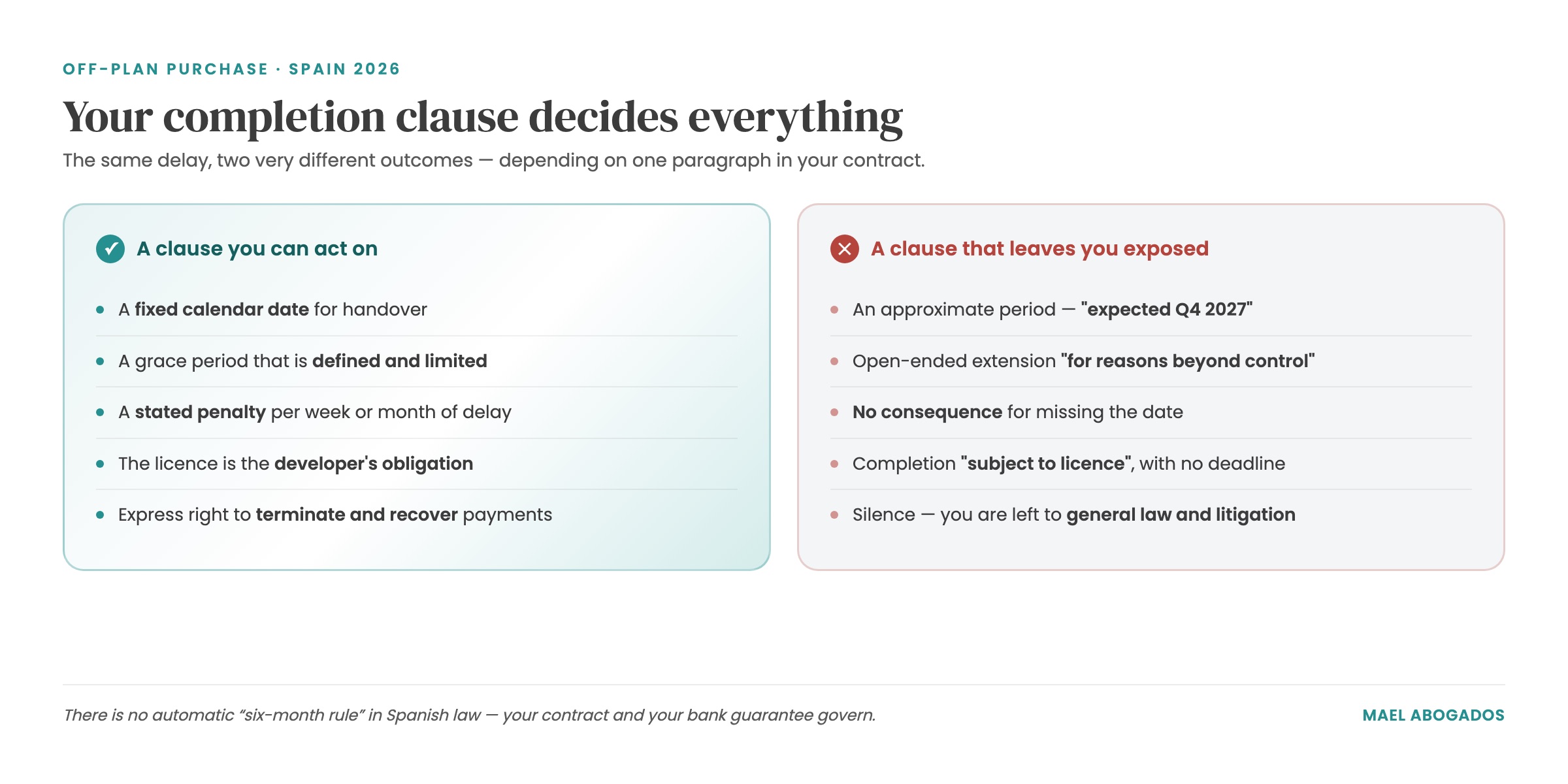
Before anything else, read the delivery clause of your private purchase contract. The difference between a clause you can enforce and one you cannot is usually a single sentence.
| A clause you can act on | A clause that leaves you exposed |
|---|---|
| A fixed calendar date for handover (“no later than 30 June 2027”) | An approximate period (“delivery expected in Q4 2027”) |
| A grace period that is defined and limited (“plus a maximum of three months”) | An open-ended extension “for reasons beyond the developer’s control” |
| A stated penalty for each week or month of delay | No consequence at all for missing the date |
| Completion tied to a date, with the licence as the developer’s obligation | Completion “subject to obtaining the first occupation licence”, with no deadline |
| An express right to terminate and recover payments after a set delay | Silence — leaving you to rely on general law and litigation |
This is why buyers largely win or lose the delay fight before they sign. A proper due diligence review of the developer and the contract is the moment to fix a vague completion clause. Do it then, not after the crane has stopped moving.
When off-plan delays let you terminate the contract
Spanish law lets a buyer terminate a contract when the other party fails to perform its obligations. The rule is in article 1124 of the Spanish Civil Code. But not every delay qualifies.
As a general rule, the courts distinguish between a delay and a breach serious enough to justify unwinding the purchase. What tends to matter is whether the delay frustrates the practical purpose of the contract. In plain terms: has the delay effectively denied you the thing you bargained for? A short overrun on a home you plan to keep for twenty years is one thing. A delay that runs past a date your mortgage offer, visa timetable or home sale depended on is quite another.
Where the contract makes the date essential, or attaches consequences to missing it, your position is considerably stronger. Where it does not, you are asking a court to infer that the delay was material. That is possible, but far less certain.
Demand performance, or terminate?
You generally have both routes available, and they lead to different places. Demanding performance keeps the purchase alive and lets you claim any agreed penalties as they accrue. Terminating unwinds it and triggers repayment. You cannot comfortably do both at once, so the choice is strategic. Suppose the development is nearly complete and prices have risen. Keeping the contract may then be worth far more than getting your deposit back.
What happens to the money you have already paid
On this point, Spanish law gives off-plan buyers more protection than they often realise. Developers who take payments on account before handover must secure those amounts. The current rules come from Ley 20/2015, which reformed the guarantee provisions of the Ley de Ordenación de la Edificación.
The guarantee can be a bank guarantee or an insurance policy. It covers the case where construction does not start, or does not reach completion, within the agreed term. Where that happens, you can recover the amounts you advanced, including the taxes you paid on them, plus statutory interest. You do not have to depend on the developer’s own solvency. That is precisely why the wording of your completion date matters so much. The guarantee takes its reference from the term in your contract, so a vague term makes it harder to call in.
There is an important boundary here that most articles skip. The law frames the guarantee around construction that does not start or does not reach completion in the agreed term. That is not always the same as a finished building handed over late. Your contract and the real stage of the works decide which side of the line your case falls on. It is one of the first things a lawyer should check.
Two checks buyers routinely miss
First, the guarantee has to actually exist and be in force. Check that it covers every payment you have made and that it has not lapsed. Second, the guarantee expressly extends to the taxes paid on those amounts. So the VAT on your stage payments is part of what it protects. Our guide to taxes on new-build property in Spain sets out what you pay and when. Our article on guarantees on off-plan purchases explains how the guarantees themselves work.
Claiming compensation for off-plan delays
Your contract may set a penalty for late delivery, such as a fixed amount per week or per month. If it does, the penalty accrues as the delay runs. Claim it in writing, in a way that leaves a record, and keep claiming as it builds. Your silence may count as acceptance.
If the contract sets no penalty, compensation is still possible, but you have to prove the loss. Think of rent you paid elsewhere, storage, or a mortgage offer you had to renegotiate on worse terms. Lost rental income counts too, if you can document it. Keep every invoice from the moment the deadline passes.
When the developer is not liable
Force majeure can relieve a developer of liability: an unforeseeable event outside its control that genuinely caused the delay. In practice, this defence is narrower than developers tend to argue. It does not cover ordinary construction risk, poor planning, financing problems or a late licence application. Supply-chain and labour excuses are common in delay correspondence. Whether they hold up is a question of evidence.
Off-plan delays: what to do the week your deadline passes
- Re-read the delivery clause, including any grace period and any conditions attached to it. Establish the exact date the developer is in default.
- Check your guarantee is alive: issuer, amount, expiry, and whether it covers every payment you have made.
- Send a formal demand through a channel that produces proof of content and delivery (in Spain, a burofax). An email chain is weaker evidence.
- Start a file. Correspondence, site photographs, the marketing material you relied on, and every cost the delay causes you.
- Ask about the licence. Find out whether the developer has applied for the first occupation licence. The answer tells you a great deal about how real the new completion date is.
- Decide deliberately between enforcing the contract and terminating it. Take advice before you say anything that might look like accepting a new date.
Advice from our desk
Most off-plan delays we see end without litigation. Developers respond to buyers who document properly and act on time. They respond far less to buyers who complain by email and wait.
Be careful about informally agreeing to a new completion date. A friendly reply confirming that a later date “works for you” may look harmless. Yet the developer could argue that it novated your contract, and with it the deadline your guarantee relies on. If the developer proposes a new date, that is a moment for advice, not a quick reply.
Finally, do not let the guarantee lapse quietly while you wait for good news. It is the single mechanism that separates a delay from a loss. Check it every few months. Our real estate legal team in Málaga reviews delivery clauses and guarantees for international buyers across the Costa del Sol. We work in English, Spanish, French, German and Italian. Weighing up a purchase that has not started yet? Our wider guide to buying off-plan in Spain covers the process end to end. Before you sign anything, also read our overview of the pitfalls of buying property in Spain.
Frequently asked questions
Is there a six-month rule for off-plan delays in Spain?
No. Spanish law sets no automatic six-month threshold after which a delay becomes a breach. The figure circulates widely online, but it does not appear in the statute. What governs is your contract’s completion date and grace period. Two other questions matter: does the delay frustrate the purpose of the purchase, and what does your bank guarantee cover?
Can I cancel my off-plan contract because of delays?
Sometimes, but not automatically. You can seek termination where the delay amounts to a breach serious enough to defeat the purpose of the contract. You can also terminate where your contract expressly gives you that right after a defined period. A short overrun on a contract with a generous grace period usually will not be enough on its own.
Will the bank guarantee refund me if the handover is late?
The Ley 20/2015 regime covers construction that does not start or does not reach completion within the agreed term. It extends to the amounts advanced, the taxes paid on them, and statutory interest. Note the boundary: that is not always the same as a finished building handed over late. Whether you can call on the guarantee depends on your contract’s wording and the stage the works have reached.
Can I claim compensation for off-plan delays?
Yes. If your contract provides a penalty for late delivery, it accrues as the delay runs. Claim it in writing as it builds. If the contract is silent, compensation is still available in principle. But you must evidence the actual loss the delay caused you: alternative accommodation, storage, financing costs or lost rental income.
What if off-plan delays come from licence or planning problems?
Obtaining the necessary licences is normally part of the developer’s own obligations. So licence problems are rarely a defence in themselves. Force majeure relief is narrow and does not extend to ordinary construction risk, financing difficulties or an application filed late. Whether a particular explanation stands up is a matter of evidence.
Should I accept a new completion date from the developer?
Not without advice. If you confirm a new date in writing, the developer could argue that you amended your contract. Your guarantee and any penalty clause both take the contract deadline as their reference point. Ask what the developer offers in exchange before you agree to anything.
This article reflects the position in Spain in 2026. It is general information, not legal advice on your particular contract. Every off-plan delay turns on the wording of the specific agreement. Speak to our real estate lawyers if your handover date has passed or is about to.