

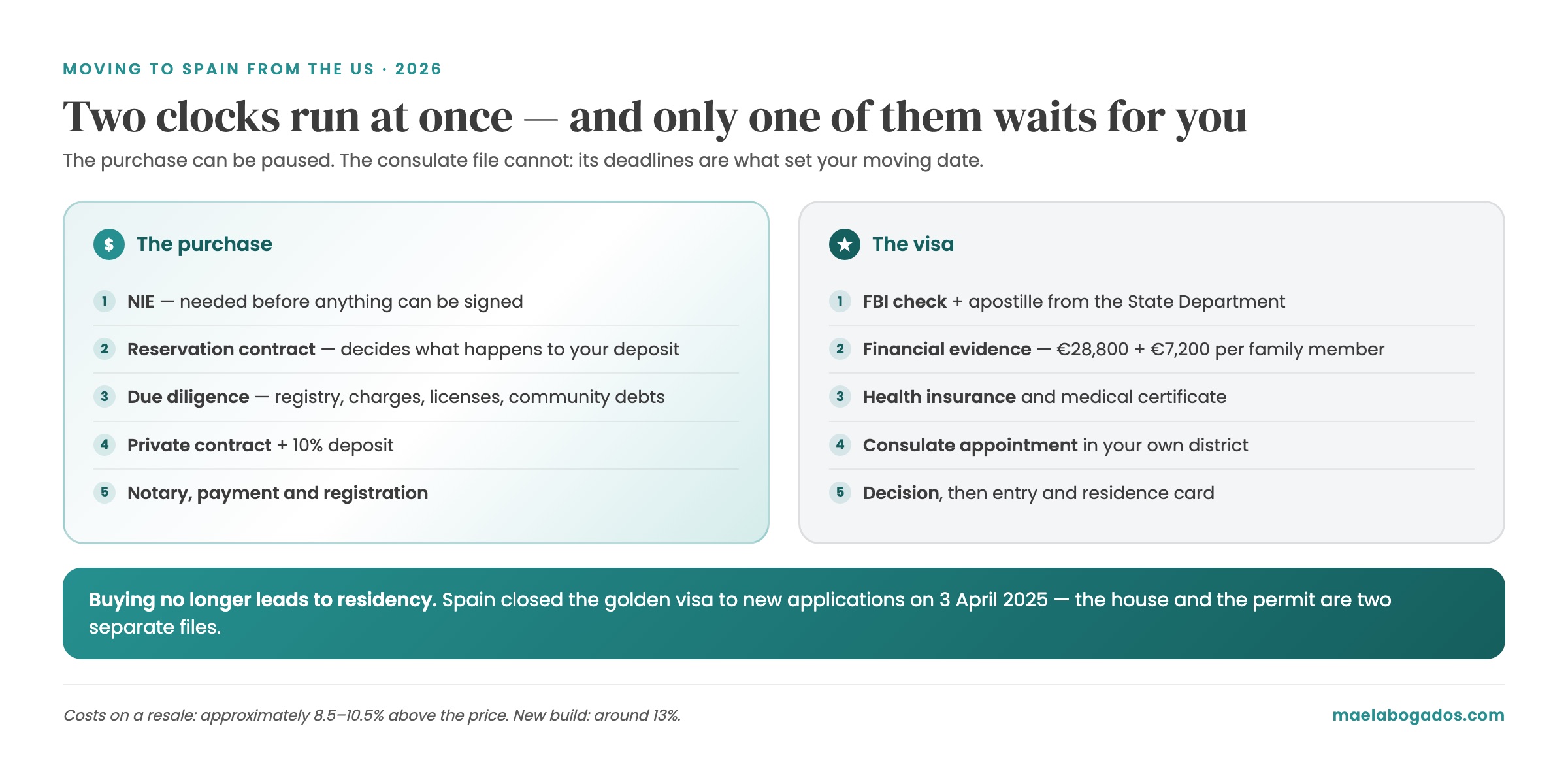
In short: Buying property in Spain as an American comes with no nationality restriction, but two things surprise most buyers. First, buying does not give you the right to live here — Spain closed the golden visa to new applications on 3 April 2025, so the house and the visa are two separate files. Second, the purchase costs about 8.5–10.5% on top of the asking price on a resale, and around 13% on a new build. You will need a NIE before you can sign anything, and your US tax filing continues whatever you do here.
Can Americans buy property in Spain?
Yes, and there is no special permission to obtain. US citizens buy on the same terms as anyone else, including Spaniards. What you do need, before the deed can be signed or registered, is a NIE — the foreigner’s tax identification number. It is not a residence permit and it does not make you a tax resident; it is simply the number the notary and the land registry need in order to record that the property is yours.
Getting it early is the single easiest way to avoid a delay later, because every other step — opening a bank account, signing a mortgage, paying the transfer tax — waits on it.
Buying property in Spain as an American does not give you residency
This is the assumption we correct most often with American clients. Until April 2025, buying property above a certain value opened the door to a residence permit through the golden visa. Spain stopped accepting new applications on 3 April 2025, under Organic Law 1/2025. Permits granted before that date remain valid and can still be renewed, but no purchase made today leads to residency.
If you are moving, not just buying, the usual route is the non-lucrative visa, which you apply for at the Spanish consulate that covers your state, from the United States, before you move. The purchase and the visa run on separate clocks — and the visa’s clock is the stricter of the two.
What buying property in Spain as an American costs on top of the price
Budget for the taxes and fees that sit above the agreed price. For a home in Andalucía:
| Concept | Resale | New build |
|---|---|---|
| Transfer tax (ITP) | 7% | — |
| VAT (IVA) + stamp duty (AJD) | — | 10% + 1.2% |
| Notary and land registry, together | €3,000–€5,000 | €3,000–€5,000 |
| Legal fees (estimate) | ~1% + VAT | ~1% + VAT |
| Total, approximately | 8.5–10.5% | about 13% |
Notary and registry go by price band: €3,000 up to €400,000, €4,000 up to €500,000 and €5,000 above. Legal fees are an estimate: around 1% of the price, with a minimum of approximately €2,000, plus VAT. You always receive a fixed written quote before you commit. Mortgage costs, if you take one, come on top.
On a €760,000 resale, that comes to about €67,400 over the price. That is €53,200 in transfer tax, €5,000 for notary and registry, and about €9,200 in estimated legal fees with VAT. You can put your own figures through our purchase cost calculator, or ask us and we will put them in writing for your specific property.
The timeline for buying property in Spain while moving from the US
When buying property in Spain as an American, most people are buying and moving at once, which is where the order matters:
- NIE first. Everything downstream needs it. You can apply for it from the US through the consulate, or here through a representative with power of attorney.
- Reservation contract. Usually a few thousand euros to take the property off the market. Read before you pay: this document already decides what happens to your money if the purchase does not complete.
- Due diligence. Land registry entry, charges and mortgages registered against the property, planning status, community debts, licenses. This is the part that protects you, and it happens before the private purchase contract, not after.
- Private purchase contract and deposit, typically 10%.
- Closing before a notary, where the price is paid and the deed signed, followed by registration and the change of utilities and taxes.
In parallel, the visa file has its own deadlines at the consulate, and they do not move for a property purchase. Starting both at once, rather than one after the other, is usually what makes the move work.
Moving the money from the United States
You will need a Spanish bank account, and the bank will ask where the funds come from — the sale of your US home, a retirement account, savings. Having that documentation ready in English and Spanish avoids the transfer sitting in compliance for weeks. Large transfers into Spain are also reported to the Bank of Spain. On the American side, a Spanish account over the reporting threshold triggers an FBAR filing of its own. None of this is a problem; all of it is a delay if you find out about it the week of closing.
What you still owe once you own it
As a non-resident owner you pay the local property tax (IBI), and Spain also taxes an imputed income on a property you keep for your own use, declared through Modelo 210. If you rent it out, you declare the rental income separately. Once you spend more than 183 days a year in Spain, you become a Spanish tax resident. That changes what you declare here. Your US filing obligations continue regardless, because the United States taxes its citizens on worldwide income for as long as they remain citizens. The US–Spain treaty and foreign tax credits are there to stop the same income being taxed twice; they do not remove either set of filings.
What a Spanish lawyer does for you here
In Spain the notary authenticates the deed and checks the formalities; nobody in that room is working for you specifically. Your own lawyer checks the registry entry and the charges, and reads the reservation and purchase contracts before you sign. They confirm the licenses and planning status and calculate the taxes. They handle the NIE and the power of attorney if you cannot travel. And they make sure the registry records in your name exactly what you paid for.
We do this every week for international buyers from our office in Fuengirola, in English, and we also handle the visa and the taxes — which for an American is usually the same conversation rather than three.
Frequently asked questions
Can Americans buy property in Spain?
Yes. There is no nationality restriction on buying property in Spain. You need a NIE number before you can sign and register the deed.
Does buying property in Spain give Americans residency?
No. Spain closed the golden visa to new applications on 3 April 2025, so no purchase leads to a residence permit. Most people moving from the United States apply for the non-lucrative visa at their consulate before moving.
How much does it cost to buy a house in Spain as an American?
Roughly 8.5–10.5% on top of the price for a resale in Andalucía — transfer tax, notary, land registry and legal fees — and around 13% for a new build, where VAT and stamp duty replace the transfer tax.
Do I need a NIE to buy property in Spain?
Yes. You need the NIE for the deed, the taxes and the registration. You can apply for it from the United States at the consulate, or in Spain through a representative holding power of attorney.
Do I pay tax in both Spain and the United States?
You may file in both. The United States taxes its citizens on worldwide income wherever they live, and Spain taxes what is connected to Spain — or your worldwide income if you become a Spanish tax resident. The double taxation treaty and foreign tax credits are designed to prevent the same income being taxed twice.
This article reflects the position in Spain in 2026. It is general information, not legal or tax advice on your particular purchase. Book a call with our property lawyers.