

In short: a US citizen becomes a Spanish tax resident by spending more than 183 days in Spain in a calendar year, or when Spain is the center of their economic interests. Spain then taxes their worldwide income, and assets abroad above €50,000 in any category must be reported on the Modelo 720. US filing continues alongside.
None of this ends your US filing: the United States taxes its citizens wherever they live. The US–Spain treaty and the tax credits on each side are designed to keep the same income from being taxed twice. They do not remove either set of returns.
When a US citizen actually becomes a Spanish tax resident
Spanish law (article 9 of the Personal Income Tax Law) sets two tests, either of which is enough, plus a presumption:
- The 183-day rule: more than 183 days in Spain during the calendar year. Spain’s tax year is the calendar year, with no split-year treatment. Sporadic absences count toward the total unless you prove tax residence in another country.
- The center of your economic interests: the main base of your activities or economic interests is in Spain, directly or indirectly, even if you spend fewer days here.
- The family presumption: if your spouse (not legally separated) and your dependent minor children live in Spain, you are presumed resident unless you prove otherwise.
If you are moving on a non-lucrative visa, the 183-day rule is built in: since May 2025, renewing that permit requires more than 183 days of real and effective residence in Spain in the calendar year (Royal Decree 1155/2024, art. 64.2.f). In practice, the visa makes you a Spanish tax resident.
What a US citizen declares as a Spanish tax resident
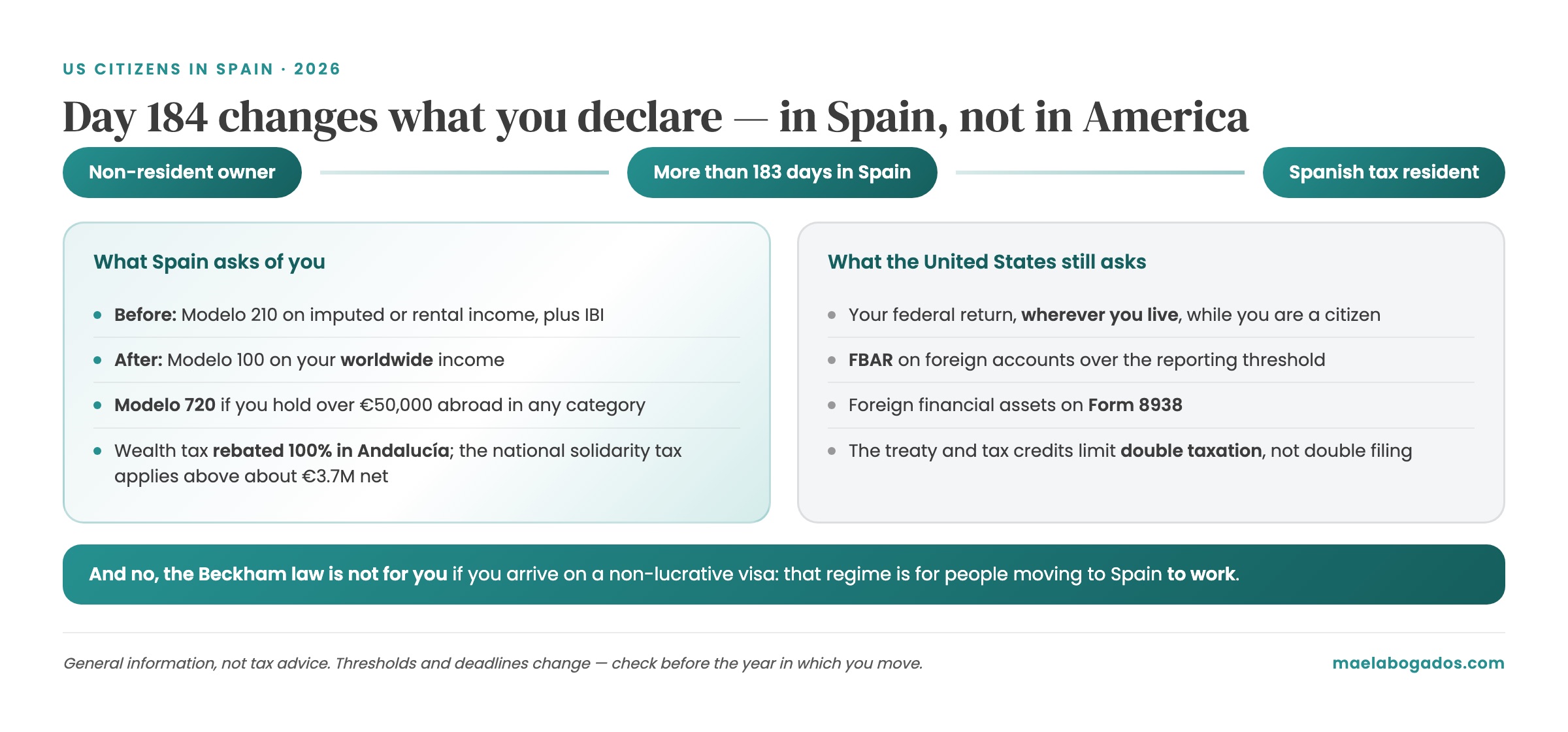
While you are still a non-resident who owns property here, Spain taxes what is connected to Spain. That covers the imputed income on a home you keep for your own use, or your rental income. You declare it on the Modelo 210, the return for Spain’s non-resident income tax. You also pay the municipal property tax (IBI).
Once you are a resident, you file the ordinary Spanish income tax return (Modelo 100) on your worldwide income. That includes US pensions and Social Security, dividends, interest and capital gains. It also includes rent from property you still own in the United States. What is taxed where, and at what rate, is where the treaty does its work.
| Return | Who files it | What it covers | When |
|---|---|---|---|
| Modelo 210 | Non-resident property owners | Imputed income on a home kept for your own use; rental income | Imputed income: by December 31 of the following year |
| Modelo 100 | Spanish tax residents | Worldwide income | April to June 30 of the following year |
| Modelo 720 | Residents with over €50,000 abroad in any category | Accounts; securities, funds, insurance and annuities; real estate | January 1 to March 31 |
| Modelo 721 | Residents with over €50,000 in crypto held abroad | Cryptocurrency with custodians outside Spain | January 1 to March 31 |
| Modelo 714 | Residents with assets over €2 million, or tax to pay | Wealth tax (100% rebate in Andalucía) | April to June 30 |
| Modelo 718 | Net wealth above about €3.7 million | Solidarity tax on large fortunes | July |
Modelo 720: the one Americans find out about too late
If you are resident in Spain and hold assets abroad worth more than €50,000 in any one of three categories (bank accounts; securities, funds, insurance and annuities; and real estate), you must file an information return, the Modelo 720, between January 1 and March 31 of the following year. It declares nothing to pay; it reports what you hold. After the first filing, you file again only when a category grows by more than €20,000 or when you stop holding something you declared. A separate return, the Modelo 721, covers cryptocurrency held with custodians outside Spain, with the same €50,000 threshold.
It has a history worth knowing. The old penalty regime was extraordinarily harsh. On January 27, 2022, the EU Court of Justice ruled it contrary to EU law (case C-788/19). It objected to the disproportionate fines and to taxing undeclared assets however many years had passed. Spain changed the rules two months later (Law 5/2022). The obligation to declare remains; what changed is the punishment for getting it wrong. For an American arriving with US accounts, retirement plans and often a house back home, this is usually the single most overlooked filing.
Wealth tax in Andalucía, for residents and non-residents
Andalucía applies a 100% rebate to wealth tax, so most residents owe nothing to the region. You still file the return (Modelo 714) if your assets are worth more than €2 million, even with nothing to pay. Non-residents whose Spanish assets are mainly in Andalucía can apply the same Andalusian rules.
The exception is the national solidarity tax on large fortunes, created in 2022 on top of wealth tax and outside the regions’ reach. After a €700,000 allowance, it taxes net wealth above €3 million (in practice, above about €3.7 million) at rates from 1.7% to 3.5%. Since the 2023 tax year, Andalucía lets those affected choose. They can take the full rebate and pay the solidarity tax to the national government. Or they can take a reduced rebate and pay a similar amount to the region instead. The tax was meant to be temporary; it has been extended until Spain reforms regional financing and remains in force in 2026.
For most buyers this is academic: on a €750,000 main home, up to €300,000 is exempt and the €700,000 allowance covers the rest. For families arriving with substantial investment portfolios, it is one of the first things to review before the move.
Why a US citizen keeps filing in America after becoming a Spanish tax resident
The United States taxes its citizens on worldwide income for as long as they remain citizens, wherever they live. Moving to Spain adds Spanish obligations; it does not replace American ones. In broad terms, you continue to file your federal return. You report foreign bank accounts over the reporting threshold on an FBAR. Foreign financial assets above certain thresholds go on Form 8938 under FATCA. Thresholds and forms change, and we do not advise on US filings. But ignoring that side while planning the Spanish one is how people end up with an avoidable problem.
What the US–Spain tax treaty does, and what it does not
The US–Spain tax treaty, updated by a Protocol in force since November 27, 2019, allocates which country may tax what. One clause matters especially to Americans: under the treaty’s “saving clause” (Article 1(3)), the United States keeps the right to tax its citizens as if the treaty did not exist, with limited exceptions, relief from double taxation (Article 24) among them. On the Spanish side, Spain credits US tax only up to what the treaty would let the United States charge a Spanish resident who is not a US citizen; how the US relieves the rest is a question for your US tax preparer.
What the treaty does not do is excuse you from filing in either country. Nor does it make the two systems agree on everything. Roth IRAs, Social Security and the sale of a former US home can all be treated differently than you expect. Those are the questions worth asking before the calendar year in which you move, not in the April after it.
And no, the Beckham law is probably not for you
Spain’s special regime for inbound workers is usually called the Beckham law (article 93 of the Personal Income Tax Law). Under it, people moving here for work are taxed under non-resident rules in their first year and the next five. It applies only if they have not been resident here in the previous five years. It depends on why you move: a job, a company directorship or certain qualifying business activity. A non-lucrative visa does not allow you to work in Spain, so the regime does not apply. Americans ask us about it often; on that visa, the answer is no.
Before you become a Spanish tax resident
The questions worth settling come before you become resident, not after. Which of your assets will Spain expect to see declared? How does Spain treat your US retirement accounts and Social Security? And what will your first Spanish return need to include?
We handle the Spanish side from our office in Fuengirola, for clients across the Costa del Sol. That means the returns, the Modelo 720 and the property taxes, through our tax advice for expats. We work alongside your US CPA or tax preparer, because neither of us can do the other’s half.
Frequently asked questions
When does a US citizen become a Spanish tax resident?
When they spend more than 183 days in Spain in a calendar year, or when the main base of their economic interests is in Spain. Spain also presumes residence, unless proven otherwise, when their spouse (not legally separated) and dependent minor children live here.
Does a US citizen who is a Spanish tax resident pay tax in both countries?
They file in both. The United States taxes its citizens on worldwide income wherever they live, and Spain taxes the worldwide income of its residents. The treaty and the tax credits on each side are designed to avoid most double taxation, but the treaty’s saving clause lets the US keep taxing its citizens.
What is the Modelo 720?
An information return listing assets held outside Spain, filed by Spanish tax residents between January 1 and March 31 when any of three categories (accounts, securities and insurance, or real estate) exceeds €50,000. It creates no tax payment by itself.
Is there a wealth tax in Andalucía?
Andalucía rebates wealth tax at 100%, though a return is still due if your assets exceed €2 million. Above about €3.7 million of net wealth, the national solidarity tax on large fortunes applies; Andalucía lets you pay that amount to the region instead.
Can I use the Beckham law if I move to Spain on a non-lucrative visa?
No. That special regime is for people moving to Spain to work, and the non-lucrative visa does not allow work in Spain.
This article reflects the position in Spain in 2026. It is general information, not tax advice, and we do not advise on US filings. Thresholds and deadlines change, so check them with a lawyer before the year you move. Book a call with our tax lawyers.