
Before you sign for an off-plan home in Spain, four documents should be in your hands and annexed to your contract. They are the specification of materials, the plans with the useful floor area, the land registry extract for the plot and the building licence. In Andalusia, the developer must also give you a free summary of all four, called the DIA.
Most buyers sign with a render and a glossy brochure in hand. That material counts, because Spanish consumer law makes concrete advertising enforceable. However, brochures change between launch and handover, and renders usually carry a “non-contractual” note. In a dispute, you would have to prove which version you saw. Whatever you sign and annex needs no such proof. That is why the off-plan documents that matter most are the ones attached to your contract, not the sales material.
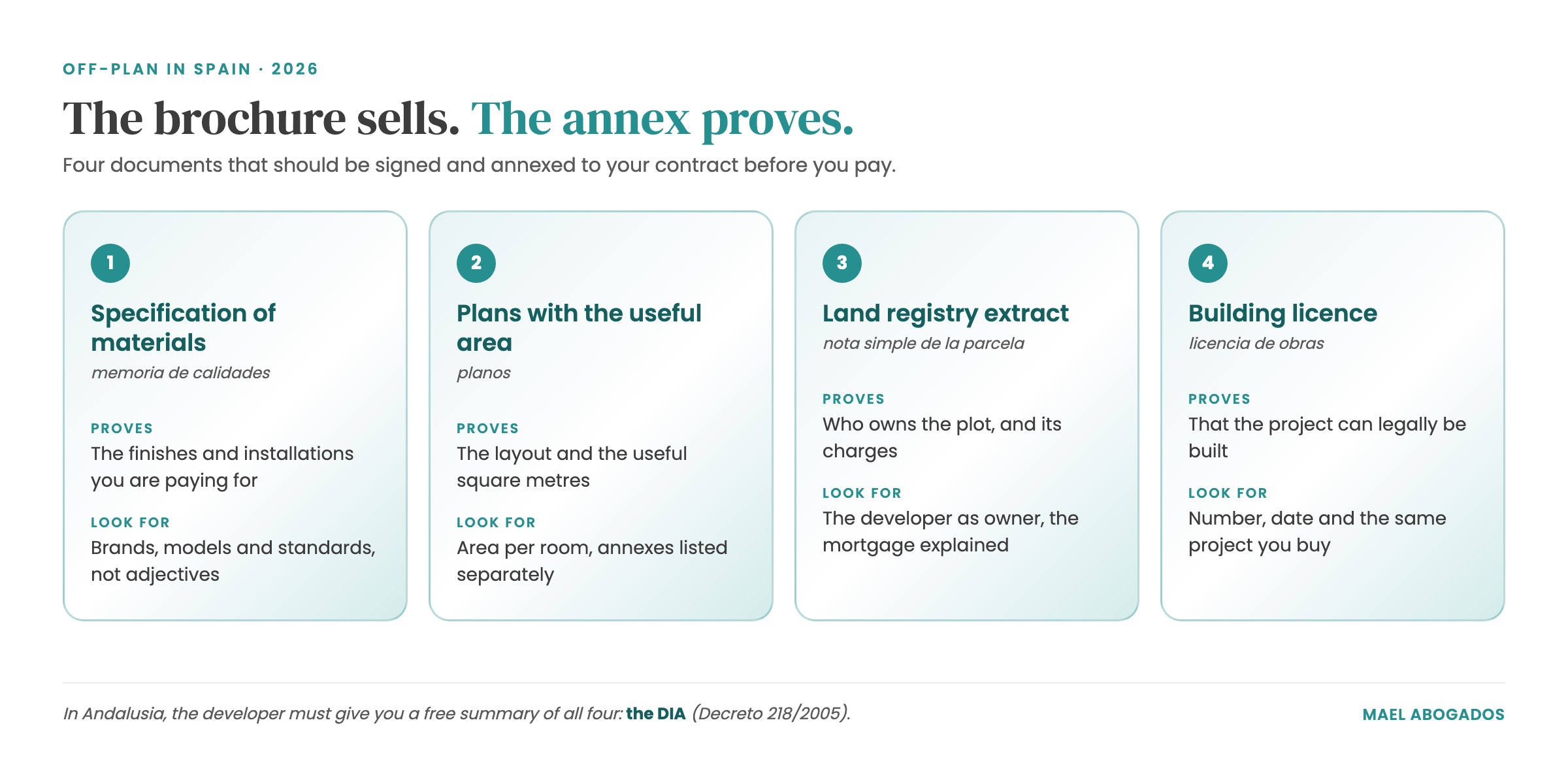
The four off-plan documents in Spain at a glance
| Document | What it proves | Red flag |
|---|---|---|
| Specification of materials (memoria de calidades) | The finishes, materials and installations you are paying for | Adjectives such as “premium” with no brand, model or standard |
| Plans with the useful area | The layout, room sizes and useful square metres of the home and its annexes | Only a built-area figure, or plans “delivered separately” |
| Land registry extract for the plot (nota simple) | Who owns the plot, and which charges or mortgages weigh on it | An owner other than the developer, or charges nobody explains |
| Building licence (licencia de obras) | That the developer can legally build the project as designed | “Licence applied for”, with no number or date |
This article is about reading those off-plan documents. The wider checks on the developer itself, from solvency to anti-money-laundering, belong to the due diligence on an off-plan property. The two work together: due diligence tells you who you are buying from, and the annexes tell you what you are buying.
Off-plan documents in Andalusia: the DIA the developer owes you
Andalusia has its own detailed rules on this. Under Decreto 218/2005, anyone offering homes in project or under construction must give a free Documento Informativo Abreviado (DIA) to any consumer who asks for information. That includes estate agents acting as intermediaries. You do not need to have reserved anything first. Asking is enough.
The DIA follows an official model. Among other things, it must include:
- a scaled location plan and a furnished floor plan with dimensions, at a minimum scale of 1:100;
- the useful area of the home and its annexes;
- a concrete, precise and objective reference to the quality of the materials and installations;
- the developer’s legal title to the plot, and any charges or easements on it;
- whether there is a building licence for an immediate start or, if not, a declaration that the project meets the planning conditions to obtain one;
- the delivery date, stated at least by quarter and year;
- who guarantees your payments on account, and the special bank account they go into.
The same rules add a second protection. At least three working days before you sign the purchase contract, you must receive copies of that documentation at the seller’s expense. So a developer who cannot produce the DIA is telling you something about the rest of the file.
The specification of materials: what binds the finishes
The memoria de calidades lists what goes into the home: flooring, windows, kitchen, bathrooms, air conditioning, insulation and installations. Once you have signed it as an annex, it forms part of the contract. The developer must then deliver what it describes.
Its value depends on precision. “Porcelain flooring” protects you far less than “porcelain stoneware, 60×60, brand and model stated, or equivalent”. The Andalusian rules ask for a concrete, precise and objective description. A vague specification therefore falls short of the standard, and the time to ask for detail is before you sign.
The “similar quality” clause
Most specifications let the developer replace materials “with others of similar quality”. Some flexibility is reasonable, because manufacturers can discontinue products during a build that often lasts two years. However, Spanish consumer law treats a clause that lets the business change the contract on its own as unfair, unless the contract states valid reasons for the change. The rule is in article 85 of the consumer protection act (TRLGDCU).
So check that the clause requires a justified cause, requires equal or better quality, and obliges the developer to tell you in writing first. An open-ended power to swap anything is a blank cheque. Negotiate it before you sign, not at handover.
Off-plan floor plans in Spain: built area, useful area and tolerances
Sales material tends to lead with the built area. It includes the walls and, often, a share of the common areas. The figure that tells you how much home you get is the useful area. In Andalusia, the useful area counts the floor inside the walls. It also adds half of your private terraces, up to 10% of the closed useful area. As a result, the two figures can differ considerably. That is why, in Andalusia, any advertising that describes the home must also state its useful area.
Ask for signed plans, annexed to the contract. They should show dimensions, the useful area of each room, and any parking space or storage room listed separately.
Surface tolerance clauses
Many contracts accept a variation in the final area, for example “plus or minus 5%”. The law fixes no percentage. It is a clause, and you can negotiate it. Check three points: which area it applies to, useful or built; whether the price goes down if the home comes out smaller; and whether you can withdraw above a certain difference. A tolerance that only ever works in the developer’s favour deserves a second look.
The land registry extract: what plot you are buying into
Before the building exists, the Land Registry entry is the plot. A recent nota simple of the plot shows who owns it and which charges, easements or mortgages weigh on it. First, check that the owner is the developer, or that the developer holds a valid right to build. Our guide to the nota simple in Spain explains how to read the extract line by line.
The developer’s mortgage
Developers usually finance construction with a loan secured on the plot. That is normal. What matters is what happens to that mortgage when you complete. In practice, the developer divides it among the homes or cancels it before your deed. Spanish consumer law gives you two protections here, both in article 89 of the TRLGDCU:
- a clause that forces you to take over the developer’s mortgage, or penalises you for not doing so, is unfair;
- the costs of the new-build declaration, the division into units and dividing or cancelling the developer’s mortgage belong to the developer.
Your contract should therefore state that the developer will deliver the home free of charges, or that taking over the loan is your choice.
The building licence: is the project legal before you pay?
The licencia de obras is the town hall’s permission to build that project on that plot. Ask for its number and date. Then check that it matches what you are buying: the same number of homes, the same floors, the same plans. “Applied for” is not “granted”. At project stage, the DIA may show a planning declaration instead of a licence. In that case, ask when the developer expects the licence and what happens to your money if the town hall refuses it.
Meanwhile, a bank guarantee or an insurance policy must protect your stage payments, and the money must go into a special account. We explain how off-plan payment guarantees work in a separate article. At the other end of the project, the first occupation licence confirms that people can live in the finished building.
When the finished home does not match the off-plan documents
This is where the annexes earn their place. At handover, compare the home with the signed off-plan documents, the specification and the plans, room by room. Write down every difference before you accept the keys. Our guide to the off-plan handover in Spain explains what to check, and in what order.
The developer must deliver what you agreed. Depending on how serious the difference is, you may ask the developer to correct it, ask for a reduction in the price or, in serious cases, seek to terminate the contract. Concrete promises in the advertising count too, because consumer law makes them enforceable even when they are not in the contract. That is why it pays to keep the brochure, the price list and screenshots of the website from the day you reserved.
Defects that appear after handover follow a different route: the statutory warranties of one, three and ten years. Our guide to off-plan warranties in Spain covers them. And if the handover date itself slips, read our article on off-plan delays.
Checklist: off-plan documents to collect before you sign
- Ask for the DIA as soon as you show interest. It is free.
- Ask for the model contract before paying the reservation, and ask what protects that money.
- Get a recent nota simple of the plot and read the charges.
- Check the building licence: number, date and match with the project.
- Read the specification for brands, models and standards, not adjectives.
- Read the plans for the useful area of each room, with annexes listed separately.
- Negotiate the clauses on material substitution and surface tolerance.
- Sign and annex every document, and never accept one “delivered separately”.
- Keep the sales material: brochure, price list and website captures.
- Use your three working days to review everything before you sign.
Advice from our desk on off-plan documents
The hardest problems we see at handover begin with a document that was “delivered separately”, or never delivered at all. Spanish rules on housing contracts say a contract should not refer to documents you were not given before or at signing. So if your contract mentions a specification you have never seen, ask for it before you sign anything.
Buying off-plan is a relationship with your developer that often lasts two years or more. The file you build before signing decides how much leverage you will have at handover. If you would like a lawyer specialised in off-plan purchases to read the annexes with you, our team works from Fuengirola across the whole Costa del Sol, in English, Spanish, French, German and Italian. To see where this step fits in the wider process, start with our guide to buying off-plan property in Spain.
Frequently asked questions
Which off-plan documents should I ask for before paying the reservation?
Ask for the DIA, the model purchase contract, a recent nota simple of the plot and the status of the building licence. In Andalusia, the developer or the agent must give you the DIA free of charge as soon as you ask for information. Also ask, in writing, what protects your reservation money.
Does the developer have to give me the off-plan documents before I sign?
In Andalusia, yes. Decreto 218/2005 requires a free DIA for any consumer who asks for information about homes in project or under construction. It also requires copies of the documentation, at the seller’s expense, at least three working days before you sign the purchase contract.
Are the specification of materials and the brochure binding?
The specification binds the developer once you have signed it as an annex to your contract. Concrete data in the advertising are also enforceable under Spanish consumer law, even if the contract does not repeat them. In practice, however, the annex is far easier to prove than a brochure or a render marked “non-contractual”.
How many square metres can the home differ from the plans?
Spanish law sets no general percentage. It depends on your contract’s tolerance clause, if there is one. Check whether the tolerance refers to useful or built area, whether the price adjusts when the home is smaller, and whether you can withdraw above a certain difference.
Can the developer change the materials?
Only within what your contract allows. A substitution clause should require a justified reason and equal or better quality. A clause that lets the developer change the specification at will, without stating valid reasons, may be unfair under Spanish consumer law.
What if the plot has a developer’s mortgage?
That is common, and it is not a problem in itself. The developer usually divides it among the homes or cancels it before completion. A clause forcing you to take it over, or penalising you for refusing, is unfair. The costs of dividing or cancelling it belong to the developer.
This article reflects the position in Spain, and in Andalusia in particular, in 2026. It is general information, not legal advice on your particular purchase. Every off-plan contract turns on its own wording and annexes. Ask our off-plan team to review your contract before you sign.