
An off-plan handover in Spain follows a set order: the first occupation licence, then the documents you must receive and, finally, the title deed, where you also receive the keys. Check each step before you move to the next. And remember that the warranty clock may already be running before you get the keys, so inspect the home straight away.
After two years of waiting, most buyers want the keys as fast as possible. That is understandable. However, the handover is the last moment when the developer still needs your signature, so it is also your strongest position. This guide explains what to ask for, what to inspect and what to sign, in that order.
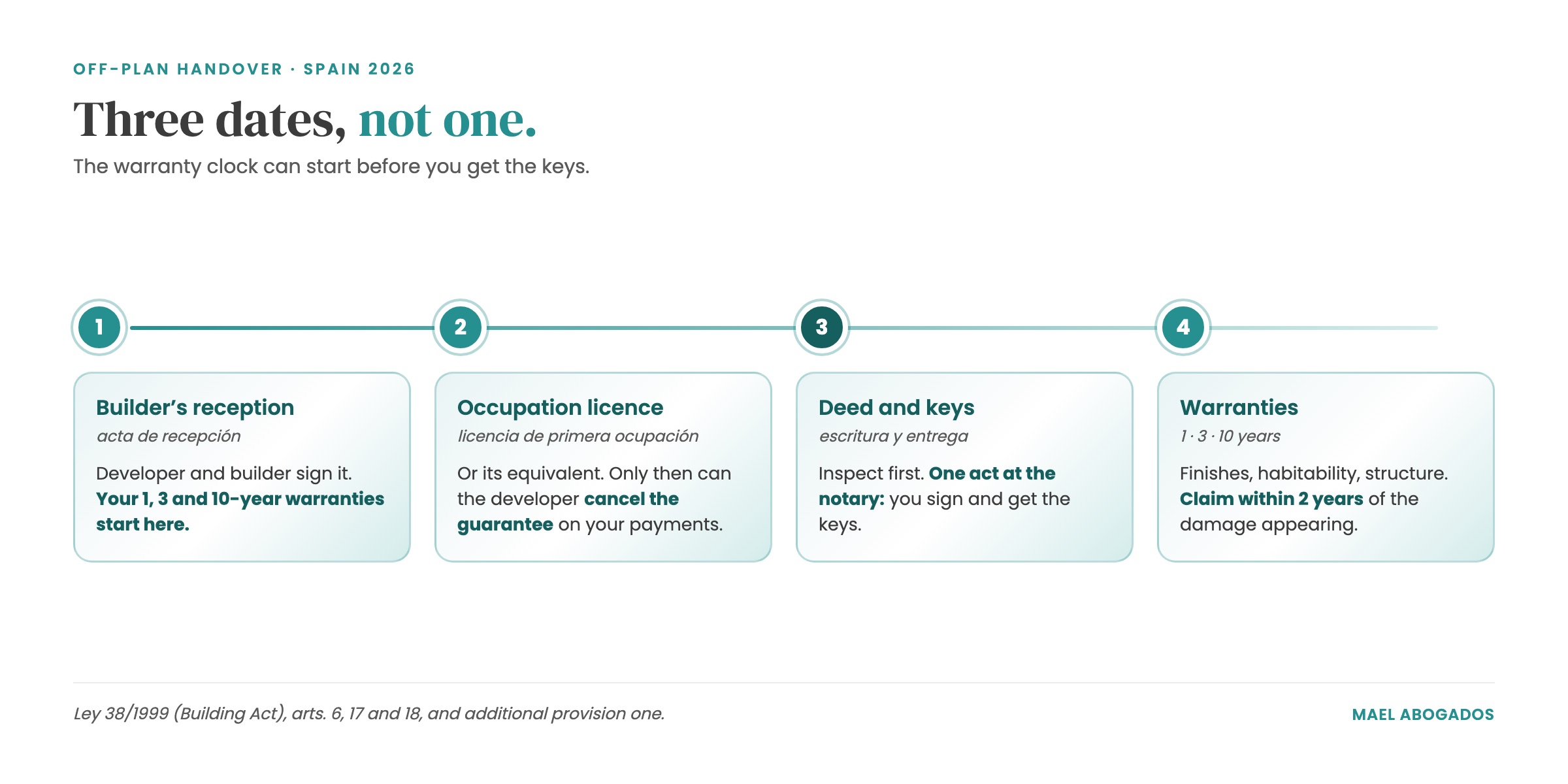
Off-plan handover in Spain: the three steps
- The licence. The town hall confirms that the finished building is fit to live in: the first occupation licence or, in many Andalusian cases, the responsible declaration that replaces it.
- The documents and the inspection. You receive the documents the law requires and inspect the home before signing.
- The deed and the keys. In a single act before a notary, you sign the purchase deed, pay the rest of the price and receive the keys.
The order matters. Each step protects the next one, and skipping one weakens your position for the rest. Our article on the first occupation licence in Andalusia explains the licence and the declaration in detail.
Off-plan handover documents: what you must receive first
In Andalusia, Decreto 218/2005 sets a clear rule. At least three working days before you sign the purchase, the seller must give you copies of these documents, at its own expense:
- the licences needed to occupy and use the home;
- the community statutes and rules, with the share that corresponds to your home;
- the insurance policies and guarantees that cover the home and its installations;
- the Libro del Edificio, the building’s own file (for a community, it goes to the owners’ association);
- a statement on whether the building has its mains supplies connected;
- a certificate showing that the seller is up to date with the property tax (IBI).
Besides the IBI certificate, the developer must provide a certificate from the community of owners showing that the home is up to date with its fees. In most cases the community has only just been set up and has not charged any fees yet, but the certificate must still be provided.
Also ask for the energy performance certificate of the finished building. During construction, the developer could only show you the project label. If anything on this list is missing, ask for it in writing before you fix the date with the notary. Our guide to off-plan documents in Spain covers the ones you checked before signing the contract.
Why the licence must come before your keys
Throughout construction, a bank guarantee or an insurance policy protects your stage payments. That protection has an end point. Under the Building Act (Ley 38/1999), the developer can cancel the guarantees once it has the first occupation licence, or its equivalent, and has delivered the home to you.
So never accept a handover without the licence or its equivalent. Without it, you would lose the guarantee and might still struggle to connect the utilities in your name. We explain how the guarantees on off-plan purchases work in a separate article.
Snagging at the off-plan handover: inspect before you accept
Snagging means inspecting the home for defects and listing them in writing. Do it before you sign the deed, or with an independent inspector if you cannot travel. Take your time: an hour in an empty flat tells you more than any brochure.
What to check
- Walls, ceilings and floors: cracks, damp patches, uneven tiles, chipped or badly grouted surfaces.
- Doors and windows: they open, close and lock properly, and the seals do not leak.
- Kitchen and bathrooms: taps, drains, extractor fans and appliances work as the specification says.
- Installations: sockets, lights, air conditioning, hot water and telecom points, where the plans show them.
- Terraces and outside areas: slopes that drain, railings that hold, finishes that match.
- What you bought: parking space, storage room, keys and remotes match the deed and the plans.
Then compare what you see with the signed specification of materials and the plans. Any difference is a defect too, even if it looks well finished.
If you find defects
Send the developer a written list with photos and ask for a repair date. Developers normally fix minor snags after completion. Refusing to sign and take the keys, or holding back part of the price, is a different matter. It only makes sense for serious defects or when the home is not what you contracted, and it calls for advice before you act.
The off-plan handover and the warranty clock
This is the point most buyers miss. Spanish law counts the 1, 3 and 10-year warranties from the reception of the works: the record that the developer and the builder sign when construction ends. That reception often happens weeks or months before your keys.
In other words, part of your one-year warranty on finishes may already have gone by the day you move in. Ask for the date of the reception record, which appears in the Libro del Edificio. And claim promptly: as a general rule, you have two years to bring a claim from when a defect appears. Our guide to off-plan warranties in Spain explains what each warranty covers.
The deed and the ten-year insurance
At the notary, in a single act, you sign the purchase deed, receive the keys and pay the balance, usually with the VAT and stamp duty explained in our guide to taxes on new-build property. Before that, check one more thing. For new homes, the law requires ten-year structural insurance, and the Land Registry will not register the new-build declaration without the required guarantees. Ask to see the policy, or its reference in the new-build deed.
If you cannot be in Spain for the signing, a power of attorney lets someone you trust sign for you. In that case, arrange the snagging inspection separately, before the signature.
After the keys: utilities and community
Developers often keep the supplies in their own name until the handover. Afterwards, you put electricity, water and gas in your name. The supply companies will usually ask for the first occupation licence, or its equivalent, and the installation certificates. Ask the developer for both at the handover, together with the manuals and warranties of the appliances.
Your community of owners also starts working: the first meeting, the fees and the building insurance. Keep the Libro del Edificio and every document from the handover. You will need them for any warranty claim and, one day, for selling.
Checklist for your off-plan handover
- Confirm the licence of first occupation, or its equivalent, before you set the date.
- Collect the documents three working days before signing: licences, statutes, policies, Libro del Edificio, supplies statement, IBI certificate.
- Ask for the energy certificate of the finished building and the community certificate that the fees are paid.
- Inspect the home, or send an independent inspector.
- Compare the home with the signed specification and plans.
- Send the developer your list of defects, with photos, and ask for a repair date.
- Check the ten-year insurance before the deed.
- Note the reception date of the works: your warranty clock.
- Put the utilities in your name with the licence and the installation certificates.
- Keep every document in one file.
Advice from our desk
The handovers that go wrong are rarely about one big defect. They go wrong because a buyer signs in a hurry without inspecting the home, or accepts the keys before the licence. Both are easy to avoid if you know the order.
If you would like a lawyer with you at the handover, our team works from Fuengirola across the whole Costa del Sol, in English, Spanish, French, German and Italian. To see where this step fits in the purchase, start with our guide to buying off-plan in Spain. And if your handover date has slipped, read about off-plan delays first.
Frequently asked questions
What happens at an off-plan handover in Spain?
The developer obtains the first occupation licence or its equivalent and gives you the required documents. Then, in a single act before a notary, you sign the purchase deed, pay the balance and receive the keys.
Can I refuse the keys at an off-plan handover?
Not for minor snags: developers normally fix those after completion. Refusing to sign and take the keys only makes sense for serious defects or when the home is not what you contracted, and you should take advice before you do it.
When does the new-build warranty start?
From the reception of the works, the record that the developer and the builder sign at the end of construction, not from your keys. That date often comes weeks or months earlier, so inspect the home and report defects promptly.
What documents should the developer give me before completion?
In Andalusia, at least three working days before signing: the licences to occupy the home, the community statutes, the insurance policies and guarantees, the Libro del Edificio, a statement on the supply connections and the IBI certificate. The developer must also provide the community’s certificate that the fees are up to date.
Should I hire a snagging inspector?
It helps, especially if you live abroad or the home is large. An independent inspector produces a detailed, photographed list that is harder to dismiss. Either way, compare the home with your signed specification of materials and plans.
What if I find defects after moving in?
Report them to the developer in writing as soon as they appear. The 1, 3 and 10-year warranties cover finishes, habitability and structure, and as a general rule you have two years to claim from when the damage appears.
This article reflects the position in Spain, and in Andalusia in particular, in 2026. It is general information, not legal advice on your particular purchase. Every handover depends on your contract and on the developer’s documents. Talk to our team before your handover date.